
I've been thinking about thoughts and prayers.

As mass killings in schools, shopping centers, a Las Vegas concert, synagogues, and elsewhere have proliferated, we hear the now-routine response, “our thoughts and prayers are with the victims and their families,” a phrase that has become an ugly social profanity. If the only thing we taught a newcomer to our country is that gun violence is now the leading killer of our children and teenagers, they would think with good reason that we are insane.

And if they were told that the routine response to this recurring tragedy is for politicians and public leaders to offer their thoughts and prayers without any meaningful action to interrupt this violence, their diagnosis of our insanity would be confirmed. And of course it’s not just mass shootings: the same inaction, shoulder-shrugging, and thoughts and prayers have been the reaction of those in power as ICE has wielded state-sponsored and taxpayer-funded violence to execute people in the streets of Minneapolis.
As a person of faith, I have thought about and prayed over too many friends, neighbors, and strangers. Some were sick or dying, others lost in drugs or alcohol, or ruining their marriages or friendships. I prayed for our younger son when he was serving in the Peace Corps in Africa, prayed for him every day for a year and a half until the call came in January 2000 that he’d been killed in a terrible traffic accident on a rural African road.
His death confirmed my long-growing doubts about the efficacy of prayer, undermining a life-long belief that God could somehow manipulate our human experience if we asked sincerely, passionately. There was now too much evidence that God was unresponsive, too little evidence that God intervened, too little evidence that God responded to anyone’s thoughts and prayers!
Thoughts and prayers without legislative or divine action are a sick joke.
Early in January I spent five days in the hospital dealing with blood clots in both of my lungs that left me breathless and closer to death than I’ve ever been. After I made my way through the emergency, I spent the rest of January rehabilitating at home.
What I didn’t expect was how much thoughts and prayers have helped. They helped because they were not soul-less, empty phrases but acts of love. Less than an hour after my internist sent me to the Emergency Room at our local hospital, my wife, our son, our daughter and her husband were crowded into the small room, touching me, encouraging me, and exchanging information about me and my condition with doctors and nurses.

In the three days I was in intensive care, waves of love came: texts and emails, voice mail messages, cards and handwritten notes – all of them wishing me well and most of them sending love with their thoughts and prayers. A friend who lives in San Francisco flew down on my fourth hospital day, sat with me for several hours, then caught a flight home. I emailed each of my clients to tell them what happened to me and that I was postponing our sessions for a month; to a person they sent back their encouragement to take whatever time I needed before returning to work and added words of affection.
My name was on our congregation’s prayer list on Sunday – an entire community, not just my family and friends, sending loving thoughts to me in the middle of their worship. Whether or not God was involved, or listened, or cared, I felt the impact of that outpouring of support, and it meant something to me.
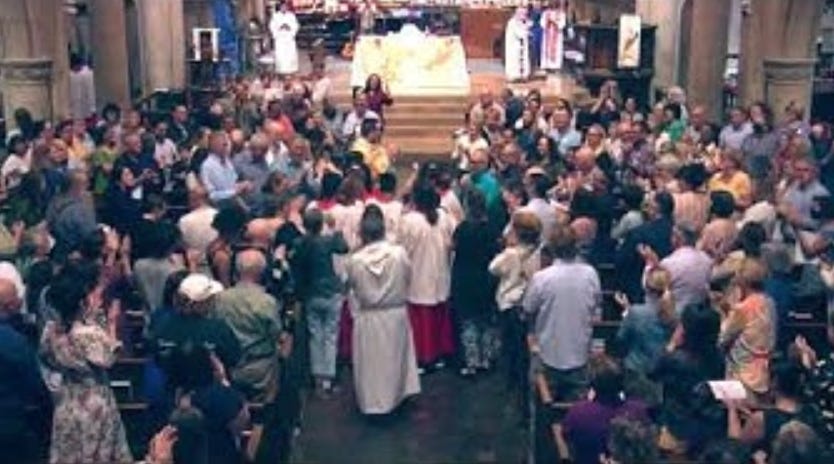
What I learned in the past month is that I don’t need God to explain what makes people courageous enough to speak up and speak out about good and evil, or to behave with loving kindness. Instead, I see thoughts and prayers combined with action as the sacredness of the ordinary, that love-driven expression of care and hope arising from the hearts of regular people.
A whole bunch of ordinary people who were there for me accomplished the extraordinary: lifting me out of my fear of death, offering their love and encouragement, and making it clear that I mattered to them and that they wanted me to stick around. I’m not smart enough to know what science would say about the impact of such love on the process of healing, but I can personally attest that it’s possible to draw strength and vivid hope from thoughts and prayers like these.
If God is Love
Like A=A
Then thinking about
And praying for
Someone's well being
Or someone's
peace that passes all understanding
Is an act of Love
Therefore
An act of God.
:)
Rick, I always look forward to reading your thoughtful, masterfully written essays. Back when I was teaching medical psychology to clinical psych PhD students, some interesting articles came out, trying to scientifically quantify the event of healing prayer – across a distance, i.e. outside of the hospital walls – for patients in the coronary care unit. Your thoughtful article brings up the same sort of intellectual/spiritual arguments that I had between different different parts of myself. This exhaustive theological/scientific essay from a very scholastic rabbi is more than you or your readers will probably want to read – but rushing through it, I found it thoughtful - and by picking out the parts that I could read quickly, I found it instructive. Do questions still remain for me about the host of conflicting belief systems that quarrel among themselves in the center of my head? Certainly. But now, this rabbi's voices can join mine. Here is his summary, which may be enough for you. Conclusion:
Prayer offers empirically documented though tentative support for adjunctive
benefits in medical outcomes, with the strongest evidence emerging in
psychological and quality-of-life domains rather than direct physiological
measures. Jewish theological frameworks provide a robust intellectual
foundation for understanding these effects not as supernatural bypass of
natural healing processes but as meaningful interventions that address the
spiritual and existential dimensions of illness experience. This synthesis
advocates for balanced, patient-centered care that bridges scientific
methodology with spiritual wisdom, recognizing that the question of prayer's
efficacy may be less important than the question of how prayer can be
thoughtfully integrated into comprehensive healthcare delivery. https://www.jyungar.com/essays-on-healing/2025/9/25/the-efficacy-of-prayer-in-medical-outcomes